0

Rollers, Wheels & Guides

Urethane Rollers, Wheels & Guides
Custom polyurethane guide rollers and wheels offer a unique combination of durability, elasticity, and surface protection for industrial applications. Polyurethane (cast urethane) often outperforms traditional rubber or plastic roller materials, providing exceptional abrasion resistance, controlled traction, and load-bearing strength. These qualities make urethane rollers and wheels ideal for conveyors, material handling systems, and custom machinery where long service life and non-damaging contact are critical. Universal Urethane Products specializes in manufacturing and refurbishing rollers, wheels, and guide components to exacting specifications, ensuring each product delivers reliable performance in demanding environments.



Advantages of Urethane Roller Material
Polyurethane has become a preferred roller and wheel material due to its outstanding mechanical properties and versatility. Compared to metal or rubber alternatives, urethane rollers offer significant benefits:
- Exceptional Abrasion Resistance: Urethane treads can last up to 10× longer than rubber, resisting wear from continuous use or harsh contact. This means less frequent replacements and lower maintenance costs in high-wear applications.
- High Strength & Tear Resistance: Cast polyurethane has high tensile strength and tear resistance, which prevents cuts, chunking, or delamination of the roller surface under heavy loads or torque. Even in aggressive conditions, the material stays intact.
- Shape Retention Under Load: Urethanes exhibit low compression set, so they retain their shape and spring-back after compression. A urethane wheel won’t develop flat spots easily. It maintains dimensional stability and consistent force transfer over long duty cycles.
- Chemical & Environmental Resistance: Urethane material resists oils, greases, solvents, moisture, and many chemicals. Rollers and wheels can operate in oily or wet environments without swelling or degrading. Urethane also stands up to ozone and UV exposure better than most rubber.
- Customized Formulations: The material can be formulated at different hardnesses and with additives to suit specific needs. For example, Universal Urethane can adjust the compound durometer or add UV/heat stabilizers for unique applications. Customers can also choose custom colors or qualities without sacrificing performance.
It’s clear why polyurethane is preferred over rubber or other materials for rollers: it’s more abrasion-resistant and holds up better under pressure and load. In practice, this means polyurethane rollers and wheels deliver longer service life and more consistent performance, even under conditions that would cause rubber parts to crack or wear out prematurely. Overall, urethane roller material provides a non-marring, long-lasting contact surface that protects equipment and products while keeping operations running smoothly.
Load Capacity and Durometer: Choosing the Right Hardness
One of the great advantages of polyurethane is that its hardness (durometer) can be tailored to balance load capacity vs. deflection for your rollers or wheels. Urethane is available in a wide range of Shore hardness values, from very soft and elastic to rock-hard and rigid. Selecting the proper durometer is a key design decision, as it affects how much a roller will deform under load (deflection), the traction it provides, and its wear characteristics.
In general, a lower durometer (softer) urethane yields more flexibility and cushioning, whereas a higher durometer (harder) urethane offers greater rigidity and load support. The goal is to choose a hardness that gives enough compliance for your needs (for grip or shock absorption) while still supporting the required weight without excessive flattening. Some typical categories include:
- Soft Urethane (e.g. 40–60 Shore A): Very high elasticity and shock absorption, but low load-bearing capability. Soft rollers will deflect easily under weight, which can protect delicate items and dampen vibrations, though they cannot support heavy loads. These are often used for cushioning pads, seals, or light-duty wheels where gentle handling is a priority.
- Medium Urethane (~80 Shore A): Balanced flexibility and strength, moderate give under load with medium load capacity, and excellent abrasion resistance. This range is a common sweet spot for conveyor rollers and drive wheels, providing a mix of impact absorption and firmness. An 80A polyurethane roller can carry substantial weight with minimal deformation, while still offering grip and resilience.
- Hard Urethane (90 Shore A): Very stiff with minimal deflection, suitable for supporting heavy loads. High-durometer rollers have low elasticity but can bear significant weight and stress without compressing. They also exhibit extremely high wear and tear resistance. For example, 90A urethane is used in coil handling pads, heavy-duty wheels, or anywhere a firm, load-bearing surface is needed.
- Very Hard Urethane (95A – Shore D range): At the upper end of Shore A (approaching 95A), polyurethane becomes almost rigid – beyond this point, the Shore D scale is used for plastics. A 60D urethane is nearly as hard as nylon and can carry maximum loads with essentially no flex. Such ultra-hard formulations are used for specialized roles like scraper blades or forklift wheels. However, most rollers and guides do not require this extreme hardness unless they must mimic a plastic/metal part.
Choosing the right durometer is about finding the optimum trade-off between flexibility and support for your specific application. A softer roller will cushion and grip, protecting delicate items or providing traction, while a harder roller will support more weight and last longer under abrasive conditions.
Universal Urethane’s engineering team can recommend the appropriate hardness based on your load requirements and performance goals. By selecting the proper urethane hardness, you can ensure your rollers and wheels have the ideal deflection characteristics. Compressible enough to do the job (without damaging your product) but stiff enough to maintain shape under working loads.
Non-Marring Contact Surfaces
One standout feature of urethane rollers and wheels is that they are non-marring, meaning they do not damage or scratch the surfaces they contact. This is a crucial advantage in applications where the roller touches a finished product or sensitive material. Metal rollers or hard plastics can easily scuff, dent, or mark a surface, but a polyurethane cover provides a gentler touch.
Urethane-covered rolls are used specifically to protect sensitive surfaces during processing. For example, Universal Urethane’s wringer rolls squeeze liquids off steel strips with high pressure while maintaining non-marring contact for superior surface protection. The resilient polyurethane acts as a buffer between the metal core and the material being handled. It distributes pressure evenly and avoids any sharp contact points. As a result, even under heavy nip forces or tension, the urethane roller will not scratch or imprint on the product.
Many industries rely on these non-marking urethane rollers to handle delicate or coated materials. In coil processing lines, urethane idler rollers support moving steel or aluminum strip without leaving any scratches or marks. Similarly, in printing, textiles, or woodworking, polyurethane-covered feed rollers guide products smoothly without marring their surface finish. Urethane’s combination of elasticity and strength allows it to grip and drive products effectively while preserving their surface integrity. This non-marring quality is a key reason polyurethane has become the go-to roller material for anyone needing gentle, damage-free handling of parts and products.
Polyurethane Roller Stock & Machining Blanks
Polyurethane roller stock (urethane in rod form) is available for customers who wish to machine custom rollers, bushings, or wheel treads to their exact dimensions. Universal Urethane offers cast urethane rods in a wide range of diameters, lengths, and hardnesses to serve as blank stock for machining. Whether you need a small 1/2″ diameter rod for a bushing or an 8″ diameter log to turn down into a large roller, you can source the material in the appropriate size. Our standard cast urethane rods are abrasion and chemical-resistant, meeting the highest industry standards for quality. Every rod is made in the USA and shipped with care, so you know you’re getting consistent, high-performance material.
Using urethane rod stock for prototyping or low-volume needs can be very convenient. You can cut or lathe the rod to fabricate rollers and wheels on-demand. We provide rod stock in durometers from 40A (soft) up to 90A (hard), and even 65D in some cases, giving you the same range of hardness options as with our custom-molded parts. The cast rods can be ordered in standard lengths (1, 2, 3, 4 feet, etc.) and in standard colors (red, yellow, black, natural), with other colors or custom lengths available on request.
When machining polyurethane, it’s recommended to start with a rod slightly larger than your final desired diameter. This allows you to machine away the outer skin and achieve a perfect round finish and exact size. Our urethane rods come with a slight oversize tolerance on outer diameter (typically ±2% or ±0.015″). By choosing a stock size a bit above your target, you can mill or grind the roller down to precise dimensions and a smooth surface. Buyers appreciate this tip – it ensures the finished roller will be perfectly concentric and on-size after machining. For instance, if you need a 3.5″ OD roller, you might start with a 3.75″ cast rod and then turn it down to 3.500″ ±0.001″ as a final step.
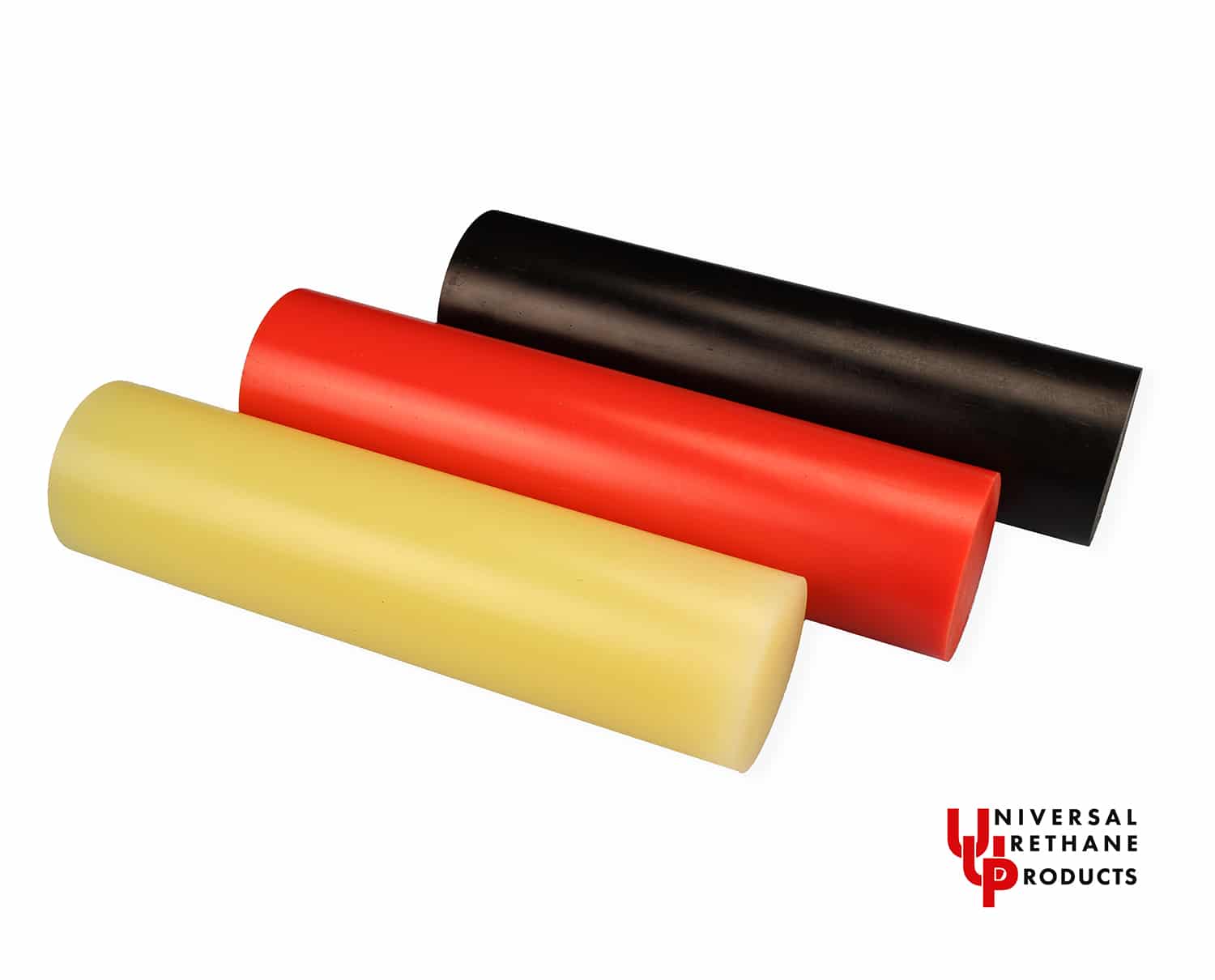 In addition to round rod stock, urethane stock shapes include sheets and bars that can be machined into various components. The material’s tough, crack-resistant, abrasion-resistant nature means it responds well to typical machining processes (sawing, turning, milling) and will hold up significantly longer than equivalent parts made from conventional rubber or plastic. Whether you are a hobbyist making custom wheels or an OEM shop crafting prototype rollers, polyurethane stock gives you the freedom to create durable urethane parts in-house. And of course, Universal Urethane is ready to assist or take over production if you require larger quantities or specialized formulations beyond what stock materials can provide.
Urethane Guide Rollers for Precise Alignment
Not only are polyurethanes used for drive wheels and transport rollers, but they also excel as guide rollers in conveyor and web-handling systems. Urethane guide rollers are designed to control alignment of belts, strips, or cables while minimizing wear and damage. A common design is the V-grooved guide roller, which cradles a belt or strip and keeps it centered on the pulley or track. The polyurethane surface provides both protection and grip. It’s hard enough to guide the material without deforming, yet soft enough to avoid cutting or marring the edges of the belt. This is essential in industries like packaging, printing, or metals processing, where a misaligned strip could cause downtime or product defects.
Universal Urethane manufactures precision-engineered urethane guide rollers that deliver reliable tracking and long-term durability. Even in challenging environments (dusty, oily, or chemically exposed conditions), our guide rollers maintain traction and alignment. The urethane material’s resistance to oil and corrosion means the guide won’t degrade when used near lubricated machinery or processing fluids. Many customers choose polyurethane guides specifically because they can set it and forget it – the roller will keep on rotating smoothly and keep the line running true, with minimal maintenance.
We also offer a variety of groove profiles and surface geometries for guide rollers to suit different guiding needs. Common configurations include standard V-grooves, U-grooves, spiral or helical grooves, diamond knurl patterns, and custom profiles. For example, a V-guide roller might have a 90° V groove that perfectly fits the thickness of your conveyor belt’s tracking rib. Or a helix groove might be used on a steering roll to gently force a strip toward the center. These engineered groove patterns maximize guidance while preserving the urethane’s integrity. By distributing contact forces and aiding in self-cleaning (shedding debris or liquids), the right groove design enhances both tracking performance and roller life.
Overall, urethane guide rollers give you precise control over material alignment without the risk of damage. They combine the mechanical strength to hold positioning tolerance with the forgiving touch that prevents scratching or edge wear. If your process involves keeping a product or strip on course, a polyurethane guide roller is often the best solution for the job, ensuring tight tracking and non-marring support from start to finish.
Engineered Cores, Bonding & Surface Finishes
Most industrial urethane rollers and wheels consist of a polyurethane outer tread bonded to an inner core or hub. The core provides structural support and a means of mounting the roller (such as a shaft, bearings, or other hardware), while the urethane outer layer provides the working surface. At Universal Urethane, we engineer each roller’s core and bonding process for maximum performance:
- Core Materials & Construction: We fabricate roller cores from materials like steel, stainless steel, aluminum, or engineered polymers, depending on the application’s strength and weight requirements. Cores can be solid or tubular. Steel cores are common for heavy loads, while aluminum cores can save weight for better rotational inertia. Each core is precision-machined. We custom-manufacture or refurbish journals, bores, and bearing seats to ensure perfect fit and concentric rotation. This precise core fabrication means the roller will run true without wobble or imbalance.
- Proprietary Bonding Process: A critical aspect of polyurethane roller production is achieving a strong, permanent bond between the urethane and the core. Universal Urethane uses a proven multistep bonding process: the metal core is grit-blasted to roughen the surface, coated with specialty primers, and then the hot-cast urethane is poured or molded onto it and heat-cured. This chemical bonding method creates an extremely robust adhesion – the polyurethane essentially becomes one with the core. Our bonding is so secure that the urethane will not separate or peel even under high torque, heavy loads, or continuous cyclic pressure. (Every new design can be validated with destructive bond pull testing to guarantee safety.)
- Dynamic Balancing & Finishing: After casting the urethane and curing, rollers are finely ground to exact dimensions and surface finish requirements. We can grind the outer diameter to precise tolerances (within a few thousandths of an inch) and achieve the specified surface roughness (from smooth polished to textured). Additionally, for high-speed or large rollers, we perform dynamic balancing of the complete assembly. Balancing eliminates vibration and ensures the roller/wheel can operate at speed without causing machine wear or quality issues. The final product is a true-running, concentric roller that meets all print specifications for size and finish.
- Custom Surface Finishes & Grooves: Depending on your needs, we can craft virtually any surface pattern or texture on the urethane. Options include smooth ground finishes for non-marking contact, or rougher textured finishes to increase grip (we can achieve specific Ra surface roughness values on request). We also offer a wide array of groove patterns and profiles: from straight grooves and cross-hatch patterns to diamond, herringbone, spiral, chevron, or checkerboard grooves for specialized traction or fluid displacement. These customizations allow the roller to be optimized. For example, grooved rollers can channel away water or coolant, or provide extra bite to move a product without slippage. All grooves are engineered to balance effectiveness with urethane durability, so the roller maintains its strength.
Complete Assemblies: For convenience, Universal Urethane can supply rollers and wheels as complete assemblies, ready to install. This means we provide the urethane-covered roller with shafts, bearings, bushings, end caps, or couplings pre-assembled as needed. By delivering a turnkey assembly, we ensure that all components fit correctly and the roller can be dropped into your machine with minimal effort. Our team will work from your drawings or worn samples (per print) to match every detail. We take pride in holding tight tolerances and high consistency across every production run, so replacement rollers perform just like the originals.
over 50 years of polyurethane casting expertise
Universal Urethane’s comprehensive approach, from in-house core fabrication to custom urethane formulation and finishing, means you get precisely engineered rollers and wheels that meet your performance requirements. With over 50 years of polyurethane casting expertise, we have encountered nearly every design challenge and have the know-how to optimize each component. The result is a roller or wheel that delivers superior grip, longevity, and protection compared to off-the-shelf solutions.
If you have further questions about designing a urethane roller, wheel, or guide for your equipment, our engineers are here to help. Whether you need a one-time custom piece or high-volume production, we take responsibility for the entire process. There is no product too small or too big for us to make. Feel free to contact Universal Urethane Products for expert guidance or to request a quote on your urethane roller needs. With the right material selection and design, your urethane rollers, wheels, and guides will provide non-marring, reliable service that keeps your operations rolling efficiently
Contact Us
Request a Quote