0

Scraper Blades & Squeegees
Scraper and squeegee Blades
Polyurethane (urethane) scraper blades and squeegee blades are essential in many industries for cleaning, material handling, and surface protection. Urethane has become the material of choice for these blades because it offers superior abrasion resistance and tear strength over rubber or plastic alternatives.
Polyurethane blades can withstand harsh conditions (oils, chemicals, rough surfaces) without degrading. They are also flexible enough to reduce noise and avoid scratching surfaces – unlike metal blades, which can be loud and damaging. In fact, polyurethane is even non-marking on nearly any surface, so it won’t leave scuffs on floors or products.
Thanks to this unique combination of durability, flexibility, and surface-friendliness, polyurethane is widely used for scraper and squeegee applications. It’s common to find polyurethane scraper blade material in everything from floor cleaning machines to conveyor belt systems. These blades last significantly longer than rubber (often 4–5× longer in abrasive conditions), translating to less frequent replacements and lower maintenance costs over time.
contact us
Request a Quote
Common Use Cases for Polyurethane Blades
- Water Removal (Floor Squeegees): Soft urethane squeegee blades excel at removing water and liquids from surfaces. In floor cleaning equipment and flood cleanup tools, a polyurethane squeegee blade flexes to hug the floor tightly, creating a sealing squeegee effect that wipes the surface clean. The material’s chemical and oil resistance means it stands up to detergents, solvents, and oily grime without swelling or deteriorating. Urethane floor squeegees maintain a better seal and last longer than traditional rubber squeegees, ensuring efficient water pickup with fewer blade changes.
- Conveyor Belt Cleaning (Belt Scrapers/Wipers): Many conveyors in mining, recycling, and manufacturing use urethane scraper blades (belt wipers) to clean belts. These blades continuously scrape off carryback (residual material stuck to the belt), preventing buildup that could cause wear or tracking issues. Polyurethane is ideal here because it is extremely abrasion-resistant and can endure constant friction against the moving belt. Urethane belt wipers effectively remove debris (even sticky or rough materials) while avoiding damage to the belt itself. They are tough on debris but gentle on equipment, and their superior durability means longer service life between change-outs.
- Floor Maintenance & Equipment Blades: In industrial and commercial settings, urethane blades are used on various floor maintenance machines and attachments. This includes floor scrubber squeegees, scraper attachments for removing spills or coatings, and even snow plow edges for pavement. Urethane blades protect surfaces – they won’t gouge concrete or epoxy flooring like a metal scraper might. They also dampen vibration and noise, which is beneficial for operators (for example, a polyurethane plow edge dramatically quiets plowing noise and prevents scratching of pavement or floor coatings). Whenever a blade needs to flex to conform to uneven ground yet survive heavy use, a polyurethane blade delivers the right mix of resilience and toughness.
- Product Transfer & Material Handling: Urethane scraper blades often appear in manufacturing lines and material handling systems to move, meter, or separate products. Examples include small scraper paddles that push products along a conveyor, or squeegee-like blades that evenly spread fluids/films in a process. Polyurethane is an excellent choice here because it’s non-marking on nearly any surface, meaning it won’t scratch or contaminate the products being handled. At the same time, these blades resist wear and impact, so they can repeatedly push or wipe products without cracking or tearing. The result is gentle handling with robust performance, a critical balance for product transfer applications.
Flexibility vs. Wear: Choosing the Right Hardness
One of the most important considerations when selecting a urethane scraper or squeegee blade is its hardness (durometer). Hardness directly affects the blade’s flexibility, sealing ability, and wear life. In practice, engineers must balance flexibility vs. rigidity for the application. A softer polyurethane is very elastic and energy-absorbing, whereas a harder polyurethane is more rigid, load-bearing, and highly abrasion-resistant. In other words, a blade that is too soft may conform well but wear out faster, while a blade that is too hard will last longer but might not seal or flex as needed. Below are recommended durometer ranges (Shore A scale) for urethane blades by use case, illustrating the “flex vs. wear” trade-off:
- 60A–70A (Soft Blades – High Flex, Shorter Wear): In the lower hardness range, urethane blades are very flexible and provide excellent sealing on uneven surfaces. A ~60A blade has rubber-like elasticity. It can bend and maintain contact easily, which is great for water removal or delicate surfaces. This high flex means superior conformity (no gaps left when squeegeeing) and gentle touch. The trade-off is faster wear under abrasive conditions; soft blades have only moderate abrasion resistance, making them best suited for light-duty or intermittent use. For example, a 65A squeegee might give you a perfect floor seal but will wear down quicker if used on rough concrete daily. Choose ~60–70A when maximum flex and sealing are needed (e.g., indoor floor squeegees, light scrapers) and the duty cycle is not continuously abrasive.
- 80A–90A (Medium/General-Purpose – Balance of Flex & Wear): The 80A to 90A range is the most common sweet spot for general-purpose polyurethane scraper blade applications. At ~80A, the blade still has some give (it can flex a bit under load) but offers much higher wear resistance. Urethane around 80A resists abrasion very well while retaining moderate flexibility. By 90A, the material becomes quite stiff and tough, with very high abrasion resistance (suitable for heavy loads and constant friction). Blades in the 80–90A range thus balance flexibility and durability. They can take a beating in abrasive environments (conveyor scrapers, outdoor squeegees) yet still provide enough flex to function effectively. Many all-purpose scrapers and squeegees are made in this range to give a long service life without being overly rigid. If you’re unsure what hardness to choose, ~85A is often a reliable middle ground for combined strength and flex. (For context, industrial rollers and wheels often use 70–85A to get both traction and wear resistance. Similar logic applies to blades.)
- 90A–95A (Hard Blades – Max Wear, Lower Flex): For the most abrasive or demanding environments, such as aggregate conveyors, snow plow blades, or high-speed belt scrapers, a very hard urethane in the upper 90s Shore A (or even into Shore D) is recommended. At ~90–95A, the blade is extremely stiff. It will not flex much at all during use. This ensures it withstands heavy abrasion and impact with minimal wear. In fact, the hardest urethanes approach plastic-like hardness and can handle rough materials that would shred softer blades. The lack of flex means these blades won’t conform to small surface irregularities, but that is acceptable in scenarios where durability is paramount. For example, commercial snow plow cutting edges are typically made around 85–90A (sometimes quoted on the Shore D scale) specifically for maximum wear life against pavement. Similarly, mining belt scrapers or bucket lips might use 90A+ urethane, so they last as long as possible. Choose ~90A and above when abrasion resistance and blade longevity are the top priority, and a rigid blade is acceptable. (Note: Urethane above ~95A is usually measured on the Shore D scale; at that point, the material behaves more like an ultra-hard plastic.)
Ordering & Customization: Urethane Blade Blanks
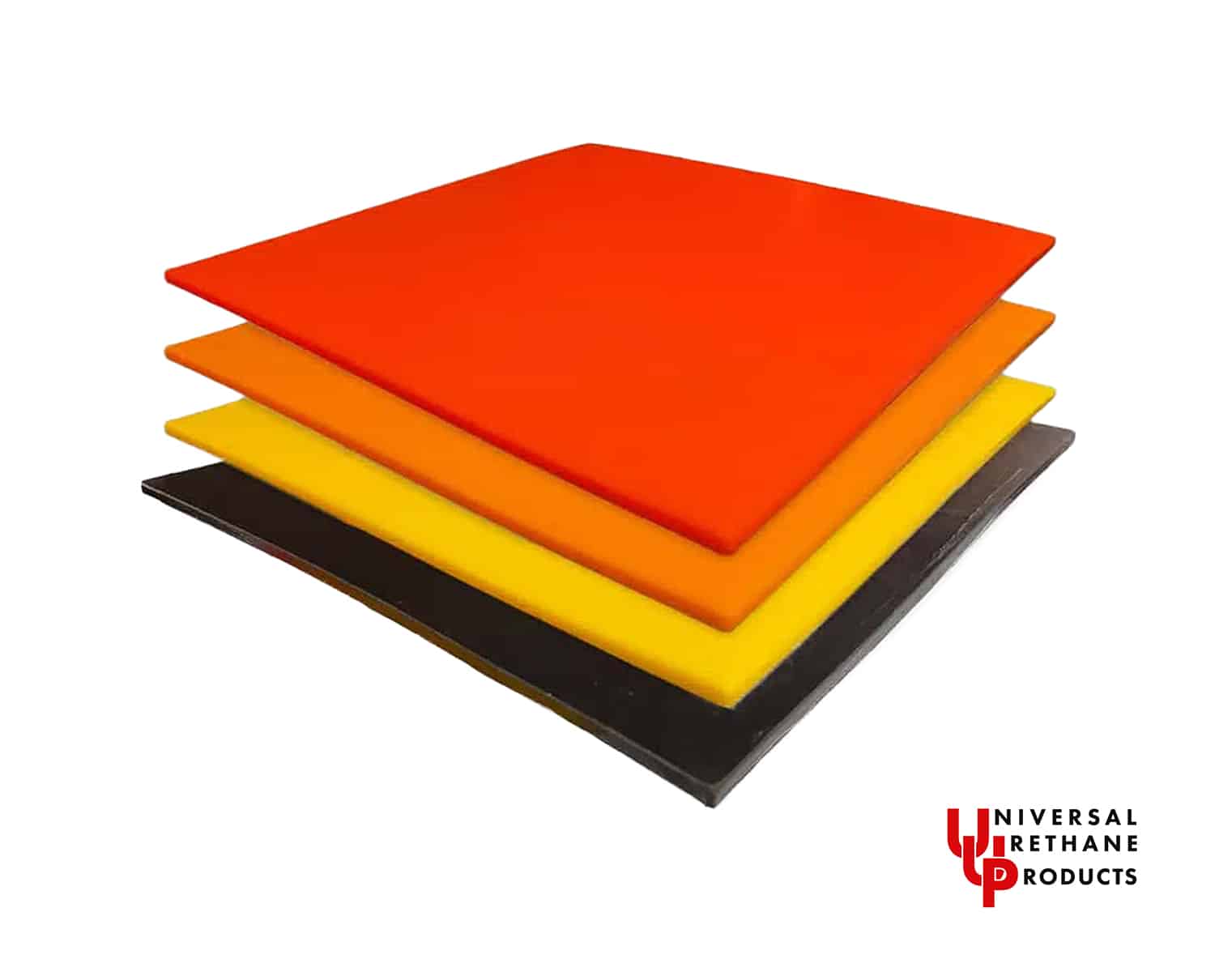
One advantage of polyurethane components is the variety of stock forms available. Universal Urethane offers standard urethane sheet and bar stock in a broad hardness range (from 40A up to 90A Shore) and in many thicknesses. For example, you can get flat urethane sheets in thicknesses of 1/8″, 1/4″, 1/2″, 3/4″, 1″, 2″, etc., and cut them into the profile of a scraper blade. Often, the easiest and most cost-effective way to obtain a custom blade is to start with stock material and machine or cut it to shape. Engineers regularly do this. They pick a urethane sheet of the desired hardness and dimensions, then trim it to the exact blade outline needed. This approach avoids the expense of making a dedicated mold for simple shapes. In fact, polyurethane bar/sheet stock is specifically advertised as a solution for quick-turnaround or small-volume needs: you can waterjet or saw-cut parts from stock for prototypes or replacements without investing in costly tooling. The material is homogeneous and machinable, so drilling holes or cutting slots for mounting is straightforward. (Typically, fastening holes are left for the customer to fabricate, ensuring the holes align perfectly with their equipment. Most stock blade blanks are shipped undrilled, as seen with our snow plow edges product, which is sold with holes not included to allow custom fitment.)
For larger production runs or more complex blade geometries, Universal Urethane can also custom cast or mold blades to your specifications. Our on-site CNC machining and mold-making capabilities enable us to create odd shapes and sizes when needed. If your application requires molded-in features, dual hardness sections, or precise edge profiles that are impractical to cut from sheet, we will manufacture a custom urethane part that meets those requirements. All manufacturing is done under one roof, from formulation to casting to finishing, which gives us tight quality control and quick turnaround for custom orders. Whether you need a one-off replacement squeegee or a batch of specialized scraper blades, we can deliver urethane blades tailored to your needs with the durability and performance that Universal Urethane is known for.
In summary, polyurethane scraper blades and squeegees offer an unbeatable combination of flexibility and wear resistance. By selecting the right durometer for your use case and leveraging the availability of urethane stock or custom molding, you can get a blade that outlasts traditional materials and improves your equipment’s performance. Universal Urethane is here to help with material selection, prototyping, and production of the perfect urethane blade, ensuring you get a solution that outlasts rubber by up to 5×, and truly sets the standard for long-lasting, reliable scraper and squeegee performance.
contact us
Request a Quote