0

Understanding Durometer
How to Choose the Right Hardness for Urethane Components
Polyurethane (cast urethane) parts are specified by durometer hardness – a Shore A or D rating (0–100) indicating resistance to indentation. Shore A is used for soft to medium elastomers, Shore D for very hard, rigid plastics. A higher durometer means a stiffer (less flexible) urethane. For example, urethanes from ~20A (very soft) up to ~90A (very hard) cover most flexible needs, while above ~95A users switch to the D scale.
In practice, urethane durometer is chosen to balance flexibility vs. rigidity for the application. Soft urethane (low Shore A) is very elastic and energy-absorbing, whereas hard urethane (high Shore A or Shore D) is rigid, load-bearing and abrasion-resistant. Below is a comparison of common hardness levels against key properties:
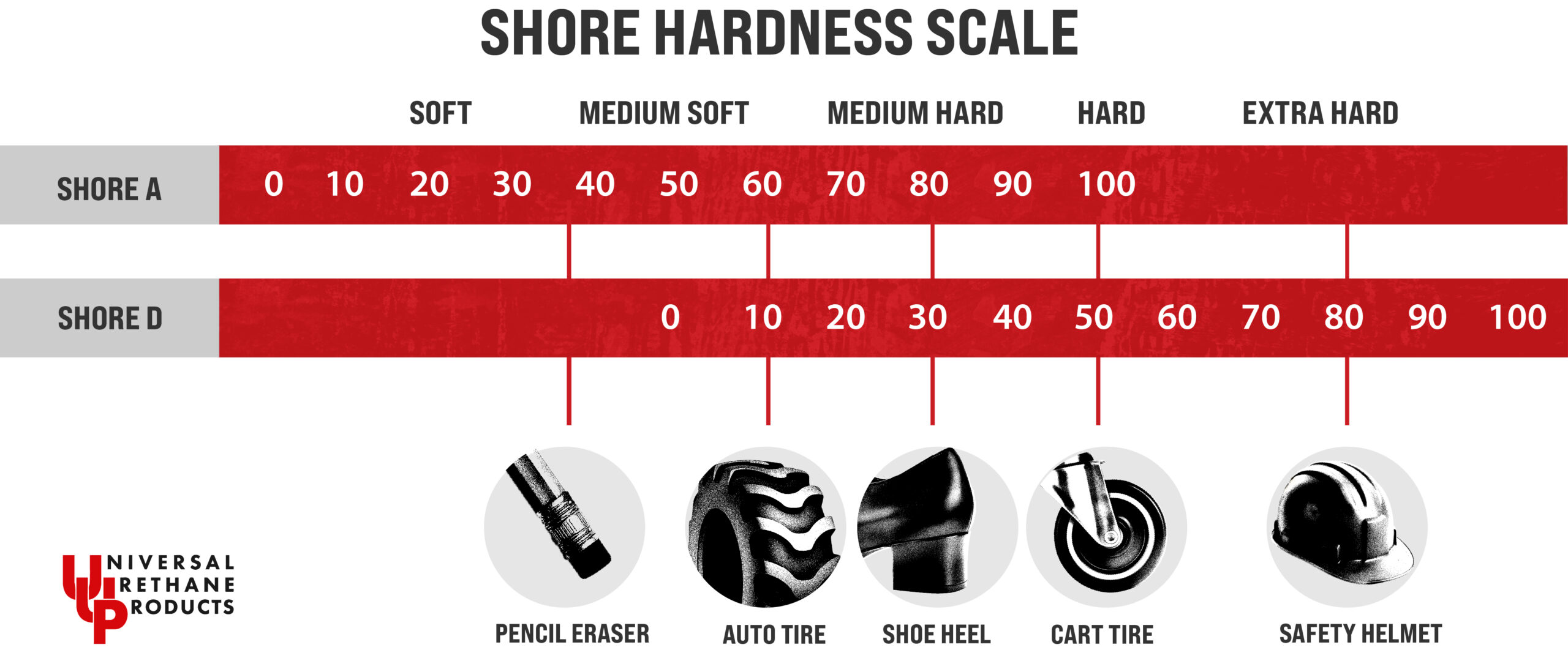
| Shore Hardness | Flexibility (Elasticity) | Load Capacity | Abrasion Resistance | Example Uses |
|---|---|---|---|---|
| 40A (very soft) | Very high – rubbery cushion | Very low – cannot support high load | Low – wears faster | Flexible seals, gaskets, soft pads (cushioning) |
| 60A (soft) | High – absorbs shock | Low – limited static load | Moderate – good for light wear | Impact/shock pads, energy-absorbing bumpers |
| 80A (medium) | Moderate – some give under load | Medium – balance of strength/flex | High – resists abrasion | Conveyor rollers, drive wheels, suspension blocks |
| 90A (hard) | Low – quite stiff | High – supports heavy loads | Very high – tough, wear-resistant | Coil storage pads, wear strips, springs |
| 60D (very hard) | Very low – almost rigid | Very high – maximum load | Very high – like nylon-like hardness | Cutting edges (e.g. snowplow blades), heavy-duty bushings |
Applications by Durometer
Engineers use these hardness categories in typical cast-urethane products:
- Coil Storage Pads (steel/aluminum coils) – Hard urethane (~80–90A) provides maximum support. These pads must bear heavy coil weight and resist abrasion. Such pads are made from the stiffest Shore A available to prevent coil damage.
- Snow Plow Cutting Edges – These demand very hard urethane to withstand abrasion against road surfaces. Commercial plow blades are typically made in the 85–90A range (sometimes quoted as Shore D values) for optimal durability.
- Impact and Shock Pads – Pads or mounts that absorb shock or vibration use soft-to-medium urethane (around 50–60A). These compounds deform to cushion impacts and have high elongation.
- Rollers and Wheels – Industrial rollers, drive wheels and pulleys commonly use medium-hard urethane (roughly 70–85A). This gives a balance: enough flexibility for traction and shock absorption while still bearing heavy loads and resisting wear.
- Bushings and Bearings – For maximum stiffness and durability (e.g. heavy-duty bushings, bearings, wear pads), very hard urethane (Shore D 50–70) is used. These compounds have minimal deflection and the highest load capacity. In wet/slurry service (grit/sand present), the hardest urethanes (65D–70D) give best life.
Many standard stock shapes (bars, rods, sheets) are offered across 40A–90A (and up to 65D), so you can machine or bond them into parts of the needed durometer. For example, Universal Urethane offers bar and sheet stock from 40A to 90A, noting that the material is abrasion and cut resistant, chemical and oil resistant. Engineers can start with stock in the desired hardness and trim to size.
Key Selection Factors
When specifying urethane hardness, consider service conditions beyond simple hardness: temperature, chemical exposure, dynamic loading, rebound, and bonding. The table below summarizes how durometer affects these factors:
| Durometer | Oil/Chemicals | Temperature | Dynamic/Impact | Compression Set |
|---|---|---|---|---|
| Soft (50–60A) | Good | –30°C to +80°C (typical) | Excellent (high rebound, very elastic) | Low (returns to shape well) |
| Medium (70–80A) | Very Good | –30°C to +100°C | Good (balanced flex & rigidity) | Moderate (20–30% @70°C) |
| Hard (90A–D) | Excellent | –30°C to +100°C | High (very stiff, shocks transmitted) | Higher (20–30% @70°C) |
| Very Hard (60D+) | Excellent | –30°C to +100°C | Very High (max load, minimal flex) | – |
- Oil and Chemicals: Harder urethanes resist oils and solvents better than soft ones. Softer grades can swell or soften in strong solvents, so for oily or chemical environments favor higher durometers.
- Temperature: Cast urethanes typically operate from roughly –30 °C up to +100 °C. All durometers share this range, but extreme temperatures can affect hardness (softening at high T, embrittling at low T).
- Dynamic Load & Rebound: Urethane has exceptionally high rebound resilience. Softer urethanes give the best shock absorption (they stretch/bounce), while harder ones are much stiffer. Choose soft for impact cushioning and hard for heavy static loads.
- Compression Set: Softer urethanes tend to have lower permanent set (better recovery) than very hard ones. If tight dimensional return under load is required (e.g. seals), a lower durometer is advantageous.
- Bonding to Metal: Cast urethanes bond strongly to metal substrates using appropriate priming agents. This allows molded or cast-in-place urethane parts (e.g. roller covers, pads) to be bonded or vulcanized onto steel hubs.
Many applications use dual-durometer urethane parts – a soft section molded or overlaid onto a hard body (or vice versa) to gain both properties in one component. For example, a pick or blade may have a hard edge for wear and a softer backing for impact damping. Consult the urethane supplier to see if a dual-shore compound or gradient hardness part would improve performance.
Selection Checklist
To choose the right durometer, engineers typically follow these steps:
- Identify the primary function: Do you need cushioning/impact absorption or wear resistance/load support? Soft urethanes (<70A) excel at shock damping; hard urethanes (>80A or Shore D) provide strength and abrasion resistance.
- List service conditions: Note exposure to heat, cold, chemicals, oil or UV. Ensure the polymer formulation (ester vs. ether base) suits these. Harder urethanes generally handle oils and chemicals best.
- Consider dynamic vs static loads: If the part flexes repeatedly, a mid-range hardness (70–85A) often lasts longest. If it carries a steady heavy load, go harder. High cyclic deflection favors softer (resilient) grades.
- Check compression requirements: If the part must maintain thickness under prolonged load (low compression set), slightly lower durometers help (choose the lowest acceptable hardness).
- Account for bonding: If the urethane will be molded onto metal, ensure proper surface preparation. Urethane can adhere firmly to steel or aluminum, so specify that you’ll be bonding it and ask about primers or bonding techniques.
- Use available data: Refer to supplier hardness charts and data. Match your needs to the examples above. By charting hardness against flexibility, load, abrasion, environment, and resilience, engineers can quickly narrow the ideal durometer. When in doubt, contact the urethane supplier’s technical team – they can recommend a compound or adjust formulation to fine-tune temperature range, rebound, or bonding for your application.
Contact Us